
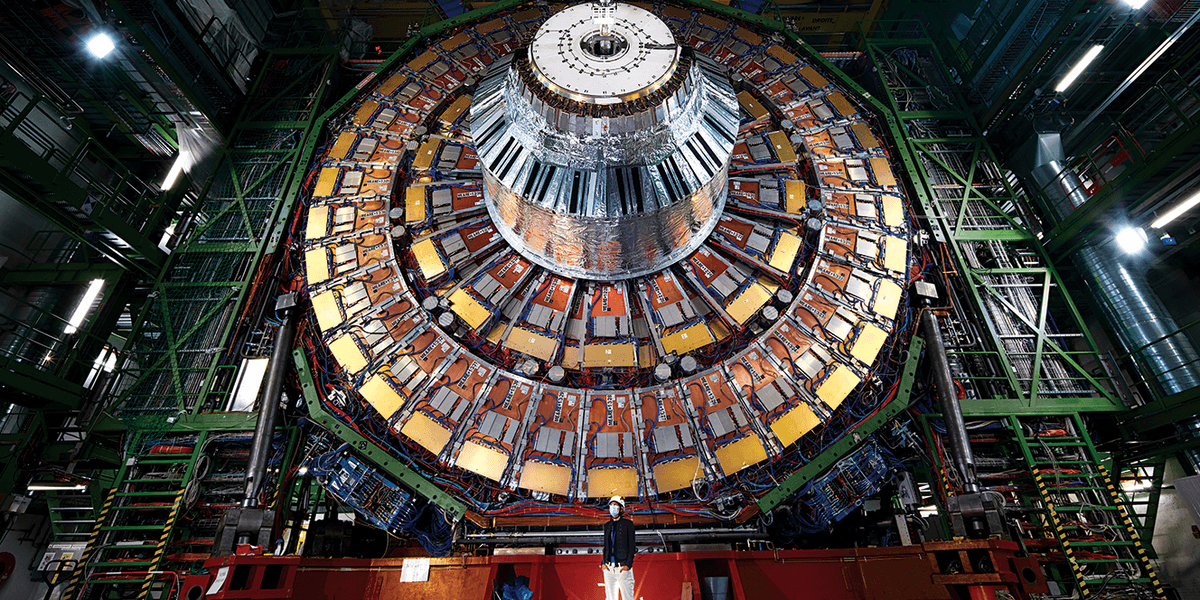

In the time it takes you to read this sentence, the Large Hadron Collider (LHC) will have smashed billions of particles together. In all likelihood, it will have found exactly what it found yesterday: more evidence to support the Standard Model of particle physics.
For the engineers who built this 27-kilometer-long ring, this consistency is a triumph. But for theoretical physicists, it has been rather frustrating. As Matthew Hutson reports in “AI Hunts for the Next Big Thing in Physics,” the field is currently gripped by a quiet crisis. In an email discussing his reporting, Hutson explains that the Standard Model, which describes the known elementary particles and forces, is not a complete picture. “So theorists have proposed new ideas, and experimentalists have built giant facilities to test them, but despite the gobs of data, there have been no big breakthroughs,” Hutson says. “There are key components of reality we’re completely missing.”
That’s why researchers are turning artificial intelligence loose on particle physics. They aren’t simply asking AI to comb through accelerator data to confirm existing theories, Hutson explains. They’re asking AI to point the way toward theories that they’ve never imagined. “Instead of looking to support theories that humans have generated,” he says, “unsupervised AI can highlight anything out of the ordinary, expanding our reach into unknown unknowns.” By asking AI to flag anomalies in the data, researchers hope to find their way to “new physics” that extends the Standard Model.
On the surface, this article might sound like another “AI for X” story. As IEEE Spectrum’s AI editor, I get a steady stream of pitches for such stories: AI for drug discovery, AI for farming, AI for wildlife tracking. Often what that really means is faster data processing or automation around the edges. Useful, sure, but incremental.
What struck me in Hutson’s reporting is that this effort feels different. Instead of analyzing experimental data after the fact, the AI essentially becomes part of the instrument, scanning for subtle patterns and deciding in real time what’s interesting. At the LHC, detectors record 40 million collisions per second. There’s simply no way to preserve all that data, so engineers have always had to build filters to decide which events get saved for analysis and which are discarded; nearly everything is thrown away.
Now those split-second decisions are increasingly handed to machine learning systems running on field-programmable gate arrays (FPGAs) connected to the detectors. The code must run on the chip’s limited logic and memory, and compressing a neural network into that hardware isn’t easy. Hutson describes one theorist pleading with an engineer, “Which of my algorithms fits on your bloody FPGA?”
This moment is part of a much older pattern. As Hutson writes in the article, new instruments have opened doors to the unexpected throughout the history of science. Galileo’s telescope revealed moons circling Jupiter. Early microscopes exposed entire worlds of “animalcules” swimming around. These better tools didn’t just answer existing questions; they made it possible to ask new ones.
If there’s a crisis in particle physics, in other words, it may not just be about missing particles. It’s about how to look beyond the limits of the human imagination. Hutson’s story suggests that AI might not solve the mysteries of the universe outright, but it could change how we search for answers.
From Your Site Articles
Related Articles Around the Web


