
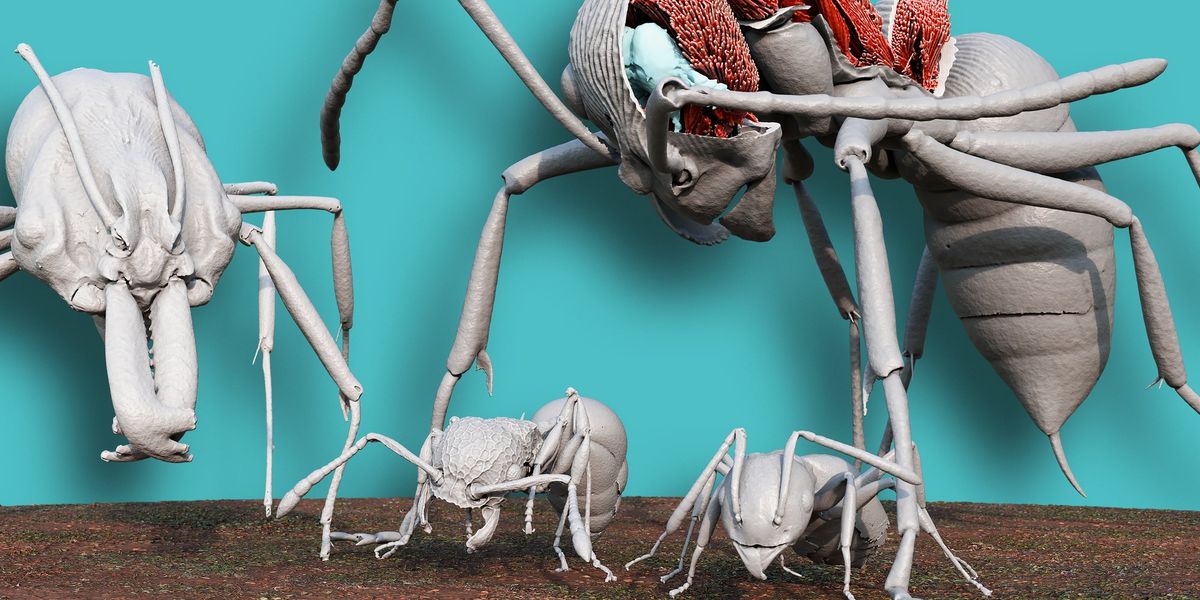

Move over, Pixar. The ants that animators once morphed into googly-eyed caricatures in films such as A Bug’s Life and Antz just received a meticulously precise anatomical reboot.
Writing today in Nature Methods, an international team of entomologists, accelerator physicists, computer scientists, and biological imaging specialists describe a new 3D atlas of ant morphology.
Dubbed Antscan, the platform features micrometer-resolution reconstructions that lay bare not only the insects’ armored exoskeletons but also their muscles, nerves, digestive tracts, and needle-like stingers poised at the ready.
Those high-resolution images—spanning 792 species across 212 genera and covering the bulk of described ant diversity—are now freely available through an interactive online portal, where anyone can rotate, zoom, and virtually “dissect” the insects from a laptop.
“Antscan is exciting!” says Cameron Currie, an evolutionary biologist at McMaster University in Hamilton, Ontario, who was not involved in the research. “It provides an outstanding resource for comparative work across ants.”
Digital Access to Natural History Collections
It also provides broader access to natural history collections.
No longer must these vast archives of preserved life be confined to drawers and jars in museums scattered around the world, available only to specialists able to visit in person. All these specimens can now be explored digitally by anyone with an internet connection, adding fresh scientific value to museum holdings.
“The more people that access and work with the stuff in our museums, whether it’s physically or digitally, the greater value they add,” says David Blackburn, the curator of herpetology at the Florida Museum of Natural History who, like Currie, was not involved in the research.
Some of those people may be professional myrmecologists (scientists who specialize in the study of ants) and fourmiculture (ant-farming) enthusiasts. But others may be school teachers, video-game designers, tattoo artists, or curious members of the public.
“It is an extremely rich dataset that can be used for a number of different applications in science, but also for the arts and outreach and education.” says Julian Katzke, an entomologist at the National Museum of Natural History in Washington, D.C.
Card-carrying members of IEEE should find plenty to explore in Antscan as well, says Evan Economo, a biodiversity scientist at the University of Maryland in College Park who, along with Katzke, co-led the project. With the dataset now publicly available and standardized at scale, “I would really like to see these big libraries of organismal form one day be useful for people in robotics and engineering, so they can mine these data for new kinds of biomechanical designs,” he says.
These renderings reveal different structures within the body of an army ant (Eciton hamatum) sub-soldier, based on Antscan data.Katzke et al.
Advancements in Ant Imaging Technology
Researchers have been digitizing natural history collections for years: photographing drawers of pinned specimens, building surface-level models from overlapping image stacks, and using computed tomography (CT) to scan select species one at a time. But those efforts are typically slow, piecemeal, and often limited to external features.
To capture entire organisms, inside and out, Economo and his team—then based at the Okinawa Institute of Science and Technology in Japan and including former lab members Katzke and Francisco Hita Garcia (now at the Museum für Naturkunde in Berlin)—built an automated imaging pipeline that effectively turned a particle accelerator into an anatomical assembly line.
They scoured museum collections around the world for ant specimens—workers, queens, and males alike—and sent some 2,200 preserved samples through a pair of micro-CT beamlines at the Karlsruhe Institute of Technology’s synchrotron light source facility in Germany.
There, biological imaging specialist Thomas van de Kamp oversaw the operation, as intense X-ray beams swept through each specimen and high-speed detectors recorded thousands of projection images from multiple angles. Robotic handlers moved vials of alcohol-preserved ants into position, one after another, all in a matter of days.
Software then reconstructed 200-plus terabytes of data generated into 3D volumes, with neural networks helping to automate the identification and analysis of anatomical structures.
Similar large-scale digitization efforts—such as the openVertebrate Project, led by the Florida Museum of Natural History’s Blackburn, which involved scanning thousands of birds, fish, mammals, reptiles, and amphibians—have begun transforming how biologists study anatomy. But applying conventional micro-CT at comparable scale to insects, which are smaller and harder to scan at useful resolutions, required a leap in speed and throughput.
That’s where the synchrotron came in. By harnessing a particle accelerator to generate extraordinarily bright, coherent X-rays, the team was able to capture high-resolution internal anatomy in seconds, without the lengthy staining or other preprocessing steps often required for soft-tissue contrast in standard lab scanners.
“It is an impressive piece of work,” says Vladimir Blagoderov, principal curator of invertebrates at the National Museums Scotland in Edinburgh, who was not involved in the research. “This project adds an industrial dimension to CT scanning by combining robotics, standardized sampling, automated image-processing pipelines, and machine learning.”
The sheer taxonomic breadth of the Antscan dataset now makes it possible to spot patterns across the entire ant family tree, as Economo and his colleagues have already demonstrated.
In a separate paper published last December, for example, the researchers drew on the newly generated scans to measure how much ants invest in their outer protective casing. Reporting in Science Advances, they showed that species with lighter, less costly cuticles tend to form larger colonies and diversify more rapidly over evolutionary time.
In their latest study, the Antscan team turned to a different evolutionary question: The distribution of a biomineral “armor” layer first described by Currie and his colleagues in 2020 in a Central American leaf-cutter ant. A quick sweep through the Antscan database revealed that this coating—which absorbs X-rays and is visible as a bright sheath over the cuticle—is not an oddity confined to one species.
Instead, it is common among fungus-farming ants, the evolutionary lineage from which leaf-cutting ants arose roughly 20 million years ago, but largely absent in most other branches of the ant tree. (Currie’s team independently confirmed the pattern using X-ray diffraction, a technique that can precisely reveal a material’s mineral composition, as the group reported last month in a preprint posted to bioRxiv.)
Those are only early demonstrations of what the database can do, though. And with AI tools increasingly capable of parsing enormous, information-rich data troves, the real analytical power of Antscan may still lie ahead, says Marek Borowiec, director of the C.P. Gillette Museum of Arthropod Diversity at Colorado State University, who has chronicled the rise of deep learning tools in ecology and evolution.
“The full advantage of this dataset will be realized when these methods are deployed,” he says.
Transforming Morphology with Antscan
The ambitions behind Antscan extend well beyond ant biology. Economo and his colleagues see it as a blueprint for digitizing, standardizing, and scaling anatomy itself.
Just as large-scale sequencing projects and genomic databases transformed the study of DNA over the past two decades, they hope Antscan will catalyze a comparable shift for morphology. “This is kind of like having a genome for shape,” Economo says.
Museum collections house millions of alcohol-preserved insects and other small invertebrates—beetles, flies, wasps, spiders, crustaceans—many of them representing rare or extinct populations. Following the Antscan playbook, each could be converted into a high-resolution library of “digital twins.“
In each case, synchrotron micro-CT would offer a rapid way to peer inside fragile specimens without cutting them open, capturing both hard exoskeleton and soft tissue in exquisite detail across vast swaths of biological diversity.
Antscan/YouTube
Beamtime at major synchrotron facilities is scarce and fiercely competitive, a practical bottleneck for any effort to digitize biodiversity at scale, notes Blagoderov. What’s more, “even once the scans exist, the downstream burden is non-trivial: Moving, storing, and processing hundreds of terabytes of data can become a bottleneck in its own right,” he says.
But if access can be secured and the computational infrastructure scaled to match, such efforts could transform natural history museums from static repositories into dynamic digital biomes.
That transformation may prove especially important at a time of accelerating species loss on Earth. By capturing organisms in extraordinary detail, resources like Antscan create a permanent, high-resolution record of life’s architecture—an anatomical time capsule that can be queried and revisited long after fragile specimens degrade or wild populations vanish.
And should Pixar ever greenlight A Bug’s Life 2 (suggested title: Even Buggier), the studio’s character designers may not need to take much artistic license at all. Thanks to a particle accelerator and a small cadre of dedicated scientists, the reference models are already in hand—rendered not in animation software but in micrometer-perfect anatomical form.
From Your Site Articles
Related Articles Around the Web


