
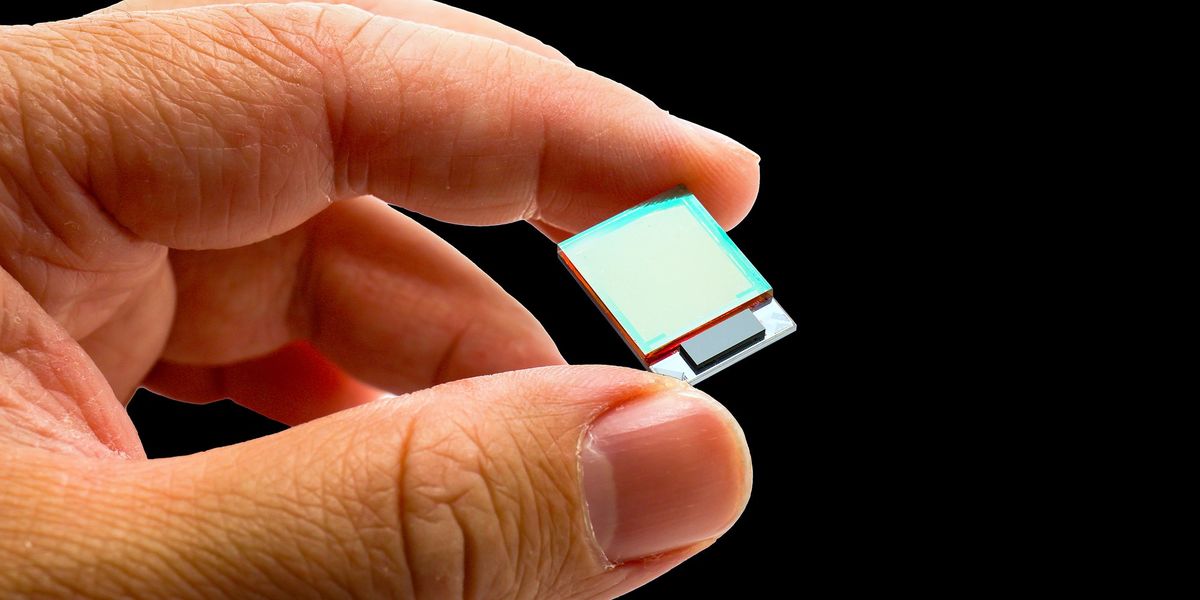

Light-warping physics made “invisibility cloaks” a possibility. Now two startups hope to harness the science underlying this advance to boost the bandwidth of data centers and speed artificial intelligence.
Roughly 20 years ago, scientists developed the first structures capable of curving light around objects to conceal them. These are composed of optical metamaterials—materials with structures smaller than the wavelengths they are designed to manipulate, letting them bend light in unexpected ways.
The problem with optical cloaks? “There’s no market for them,” says Patrick Bowen, co-founder and CEO of photonic computing startup Neurophos in Austin, Texas. For instance, each optical cloak typically only works on a single color of light instead of all visible colors as one might want for stealth applications.
Now companies are devising more practical uses for the science behind cloaks, such as improving the switches that connect computers in data centers for AI and other cloud services. Increasingly, data centers are looking to use optical circuit switches to overcome the bandwidth limits and power consumption of conventional electronic switches and networks that require converting data between light to electrons multiple times.
However, today’s optical switching technologies have drawbacks of their own. For instance, ones that depend on silicon photonics face problems with energy efficiency, while those that rely on microelectromechanical systems (MEMS) can prove unreliable, says Sam Heidari, CEO of optical metasurface startup Lumotive in Redmond, Washington.
Instead, Lumotive has developed metamaterials with adjustable properties. Its new microchip, which debuted 19 March, is covered with copper structures built using standard chipmaking techniques. In-between these copper features are liquid crystal elements. The structure of these elements are electronically programmable, just like in liquid crystal displays (LCDs), to alter the optical properties of the metamaterial chip.
The microchip can precisely steer, lens, shape, and split beams of light reflected off its surface. It can perform all the same functions as multiple optical components with no moving parts in a programmable way in real time, according to Lumotive. “Having no moving parts significantly improves reliability,” Heidari says.
“We had to go through a lot of R&D at the foundries to not only make our devices functional, but also commercially viable in terms of the right cost and right reliability,” Heidari says.
The company says its new chips are capable of manipulating not only the industry’s standard of 256 by 256 ports, but could scale up to 10,000 by 10,000. “We think this is game-changing for data centers,” Heidari says. Lumotive plans to launch its first optical switches at the end of 2026.
Similarly, Neurophos hopes its technology may prove transformative for artificial intelligence. Since AI is proving energy hungry when run on conventional electronics, scientists are exploring optical computing as a low-power alternative by processing data with light instead of electrons.
However, optical processors in the works today are typically far too bulky to achieve a compute density competitive with the best modern electronic processors, Bowen says. Neurophos says it can use metamaterials to build optical modulators—the optical equivalent of a transistor—that are 1/10,000th the size of today’s designs using standard chipmaking processes. “It’s entirely CMOS,” Bowen says. “There are no exotic materials in it.”
When a laser beam encoding data shines on a Neurophos chip, the way in which each metamaterial element is configured alters the reflected beam to encode results from complex AI tasks. “We basically fit a 1,000 by 1,000 array of optical modulators on a tiny 5 by 5 millimeter area on a chip,” Bowen says. “If you wanted to do that with off-the-shelf silicon photonics, your chip would be a square meter in size.”
All in all, Bowen claims the Neurophos microchip will offer 50 times greater compute density and 50 times greater energy efficiency than Nvidia’s Blackwell-generation GPU. The company says that hyperscalers—the world’s biggest cloud service providers—will evaluate two upcoming proof-of-concept chips this year. Neurophos is targeting its first systems for early 2028, with production ramping mid-2028.
From Your Site Articles
Related Articles Around the Web


