
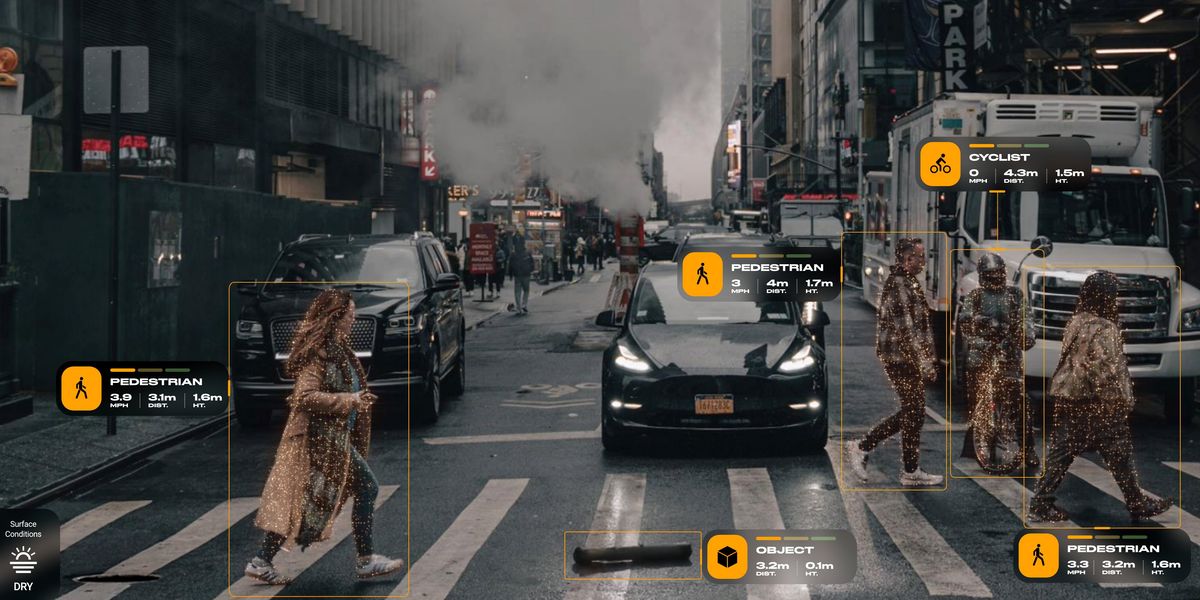

A few years ago, Matthew Carey lost a friend in a freak car accident, after the friend’s car struck some small debris on a highway and spun out of control. Ordinarily, the car’s sensors would have detected the debris in plenty of time, but it was operating under conditions that render all of today’s car-mounted sensors useless: fog and bright early-morning sunshine. Radar can’t see small objects well, lidar is limited by fog, and cameras are blinded by glare. Carey and his cofounders decided to create a sensor that could have done the job—a terahertz imager.
Historically, terahertz frequencies have been the least utilized portion of the electromagnetic spectrum. People have struggled to send them even short distances through the air. But thanks to some intense engineering and improvements in silicon transistor frequency, beaming terahertz radiation over hundreds of meters is now possible. Teradar, the Boston-based startup Carey cofounded, has managed to make a sensor that can meet the auto industry’s 300-meter distance requirements.
The company came out of stealth last week with chips it says can deliver 20 times the resolution of automotive radar while seeing through all kinds of weather and costing less than lidar. The tech provides “a superset of lidar and radar combined,” Carey says. The technology is in tests with carmakers for a slot in vehicles to be produced in 2028, he says. It would be the first such sensor to make it to market.
“Every time you unlock a chunk of the electromagnetic spectrum, you unlock a brand-new way to view the world,” Carey says.
Terahertz imaging for cars
Teradar’s system is a new architecture, says Carey, that has elements of traditional radar and a camera. The terahertz transmitters are arrays of elements that generate electronically steerable beams, while the sensors are like imaging chips in a camera. The beams scan the area, and the sensor measures the time it takes for the signals to return as well as where they return from.
Teradar’s system can steer beams of terahertz radiation with no moving parts.Teradar
From these signals, the system generates a point cloud, similar to what a lidar produces. But unlike lidar, it does not use any moving parts. Those moving parts add significantly to the cost of lidar and subject it to wear and tear from the road.
“It’s a sensor that [has] the simplicity of radar and the resolution of lidar,” says Carey. Whether it replaces either technology or becomes an add-on is up to carmakers, he adds. The company is currently working with five of them.
Terahertz transistors and circuits
That Teradar has gotten this far is partly down to progress in silicon transistor technology—in particular, the steady increase in the maximum frequency of devices that modern foundries can supply, says Carey.
Ruonan Han, a professor of electrical engineering at MIT who specializes in terahertz electronics, agrees. These improvements have led to boosts in the efficiency of terahertz circuits, their output power, and the sensitivity of receivers. Additionally, chip packaging, which is key to efficiently transmitting the radiation, has improved. Combined with research into the design of circuits and systems, engineers can now apply terahertz radiation in a variety of applications, including autonomous driving and safety.
Nevertheless, “it’s pretty challenging to deliver the performance needed for real and safe self-driving—especially the distance,” says Han. His lab at MIT has worked on terahertz radar and other circuits for several years. At the moment it’s focused on developing lightweight, low-power terahertz sensors for robots and drones. His lab has also spun out an imaging startup, Cambridge Terahertz, targeted at using the frequency band’s advantages in security scanners, where it can see through clothes to spot hidden weapons.
Teradar, too, will explore applications outside the automotive sector. Carey points out that while terahertz frequencies do not penetrate skin, melanomas show up as a different color at those wavelengths compared to normal skin.
But for now Carey’s company is focused on cars. And in that area, there’s one question I had to ask: Could Teradar’s tech have saved Kit Kat, the feline regrettably run down by a Waymo self-driving car in San Francisco last month?
“It probably would have saved the cat,” says Carey.
From Your Site Articles
Related Articles Around the Web


